
A Core Issue
Why yoga students need more than just a reminder to "engage" when it comes to building meaningful core strength (and what I'm doing about it).

A few months ago I came across this reel on Instagram. It depicts a fitness teacher instructing their student to “engage” their core. The student, unsure, asks for clarification on *how* to engage their core, only to be told vaguely: “just engage it”.
I saved it because: 1) it uses the audio from one of my favourite Schitt’s Creek episodes (“fold in the cheese”), and 2) it perfectly depicts an experience that so many of us as students of yoga and other fitness modalities have been through.

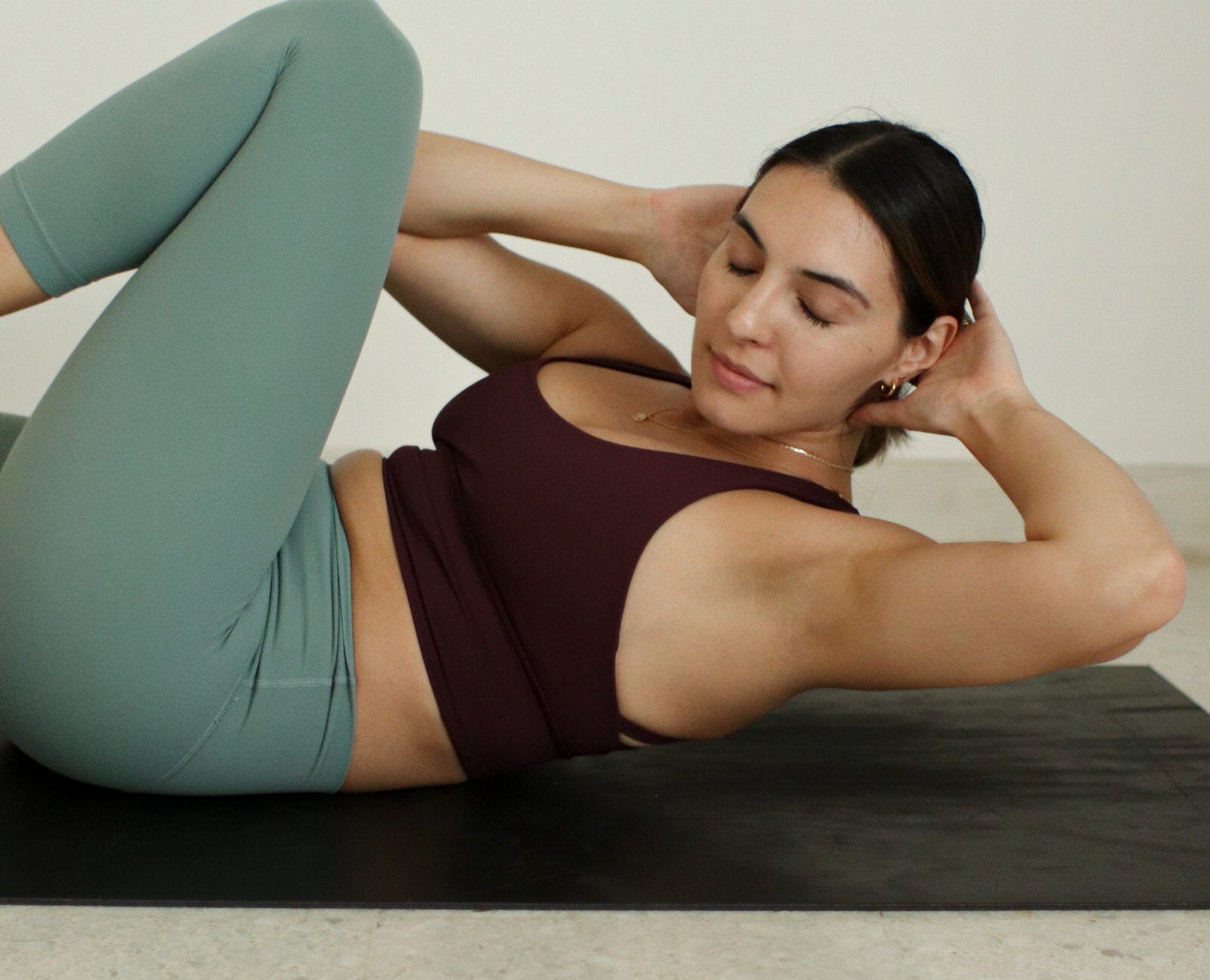
Back when I was a new student to yoga, I can remember hearing the cue “engage your core” often in class, but rarely was it ever followed by any instructions on *how* exactly to do that. So, I would just do what I thought “engaging” was: squeezing or contracting my abs. Naturally, in a lot of yoga postures this didn’t feel quite right (because it wasn’t).
As a yoga teacher who now trains other teachers on how to refine their cueing skills, I am hyper-aware of the ambiguity enshrined in a cue like “engage your core” especially for newcomers to the practice: it doesn’t explain where this movement should be happening, how to initiate it, what it should feel like or, most importantly, how to know if you’re not engaging properly (especially if you’re experiencing pain).
So all this is to say, if you’ve ever felt confused hearing this cue and wondered if it was just you—it’s not!! Core engagement is not intrinsic knowledge that we’re all born with. It’s a skill that we have to learn and practice.
A Common Thread
A few months ago my curiosity was peaked when I noticed a common thread amongst my clients in my private teaching practice.
This was surprising to me because I work mostly with individuals who are rehabbing injuries, recovering from surgery, or who have severe movement limitations. My clients’ needs are usually ultra-specific and rarely have any commonality with one another (which is why their programs are entirely bespoke).
But a few months ago as I was doing an intake session with a new client I noticed that, despite their unique circumstances, this new client (just like all the others) had listed improving core strength as one of their fitness goals on their intake form.
Although most of my clients were not able to articulate *what* exactly was lacking in their core strength, they would often say that they “just know” that their core isn’t strong or they would give the example that they struggle to hold a plank.
Regardless, all of them seemed to understand the importance of strengthening this area of their body and wanted to make it a priority.
Essential, but Elusive
Ten years ago when I first started teaching yoga, core strength was mostly seen as a vanity thing: exercises to get a six pack.
Today however, core strength is recognised as something that is essential for supporting our bodies through daily life. Most folks understand that building core strength can help with reducing back pain, that it can improve balance, gait, posture and pelvic-floor health.
For yoga students who are keen to play with arm-balances and inversions, core strength is understood to be a key ingredient to unlocking these gravity-defying poses.
But despite understanding the benefits of core strength, many of us (students and teachers alike) still don’t really know how to properly engage our core or how to effectively exercise it.
It Starts With Anatomy
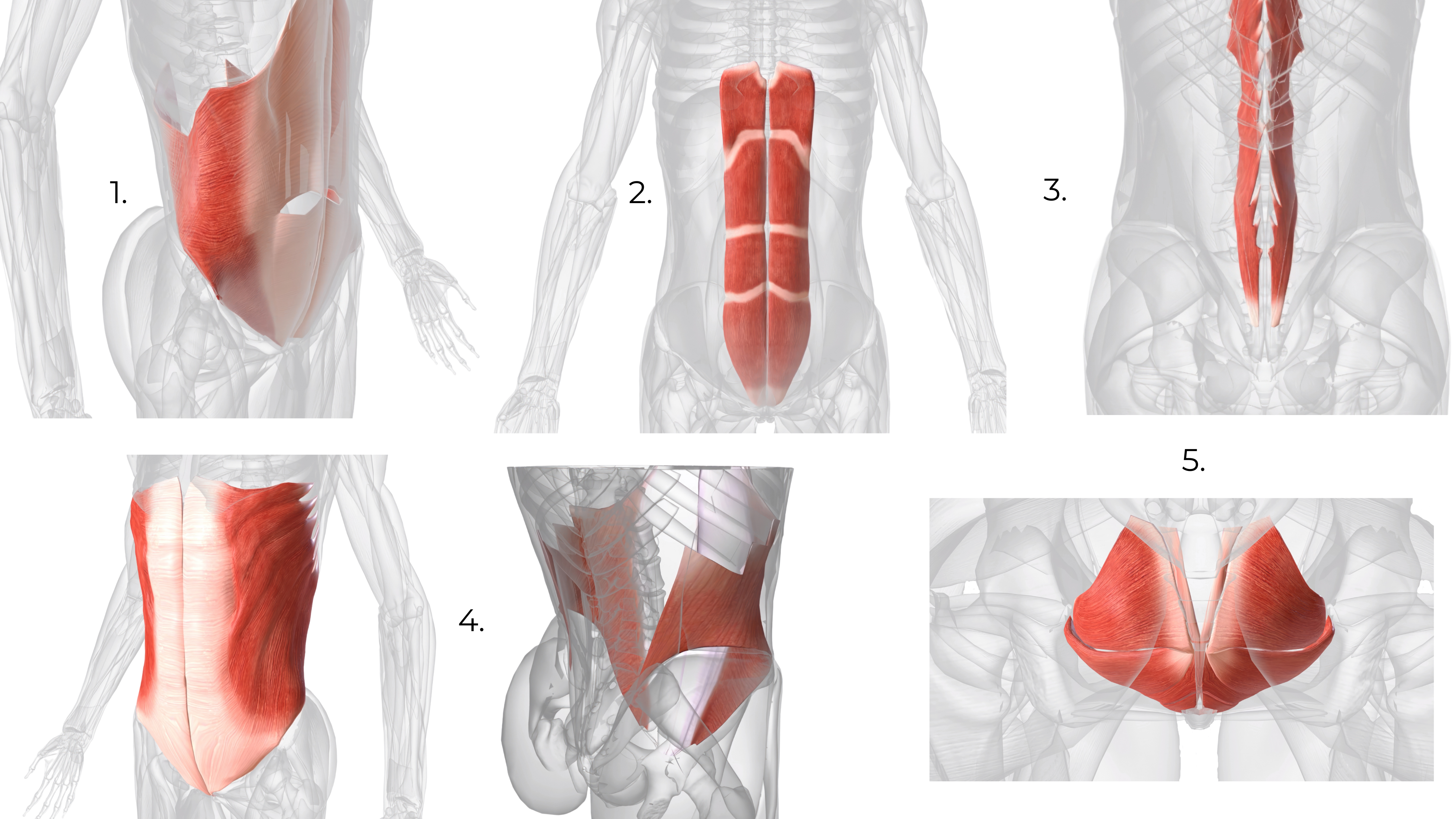
This is going to sound super nerdy but I honestly feel like understanding the core starts with understanding that it’s not just one singular muscle—it’s actually several muscles that form a “canister” in the trunk of our body. To keep things easy to understand, I like to divide the core into 5 main muscles:
Transverse Abdominus — deepest layer of our core that wraps all the way around
Rectus Abdominus — the front of our core
Back Extensors — the rear of our core
Obliques (internal obliques and external obliques) — the sides of our core
Pelvic Floor — the base of our core
All of these muscles are located in the trunk of our body BUT they won’t all be stimulated in every core exercise. So it’s important to have a well-rounded core exercise routine that trains all of these muscles evenly.
How Do We Engage?
I’m so glad you asked.
There are a few different techniques that I like to integrate into my yoga classes that help to stimulate the different muscles of the core, but my favourite to start with is always breathwork.
Yes, you read that right—breathing. The very same muscles that help to maintain our posture and protect our internal organs ALSO help us breathe.
Few of us know how to breathe in a way that effectively engages our core muscles so, whenever I’m teaching anything about core engagement, I always start by teaching the proper breathing techniques that will facilitate (and by many accounts, enhance) core engagement.
One of my favourite ways to do this uses a yoga strap wrapped around the torso to feel the muscles on the sides, front and back of the core expanding (like an umbrella opening up) on each inhalation.
Another, that will likely be controversial to the yogis reading this, is exhaling through pursed lips, kind of like blowing out candles on a birthday cake and focusing on reversing the above-mentioned expansion, hugging the outsides of the body inward. This is something that I borrowed from the Pilates repertoire that I find to be super effective for connecting to the deepest layer of our core—the transverse abdominus.
Connect to Your Core
When I discovered that “core” thread amongst my private clients, I realised that foundational core education is something that’s really missing from fitness education, especially in yoga classrooms. So I started putting together a beginner-friendly workshop for folks who want to learn how to train their core safely and effectively.
I have two upcoming offerings where I’ll be sharing this:
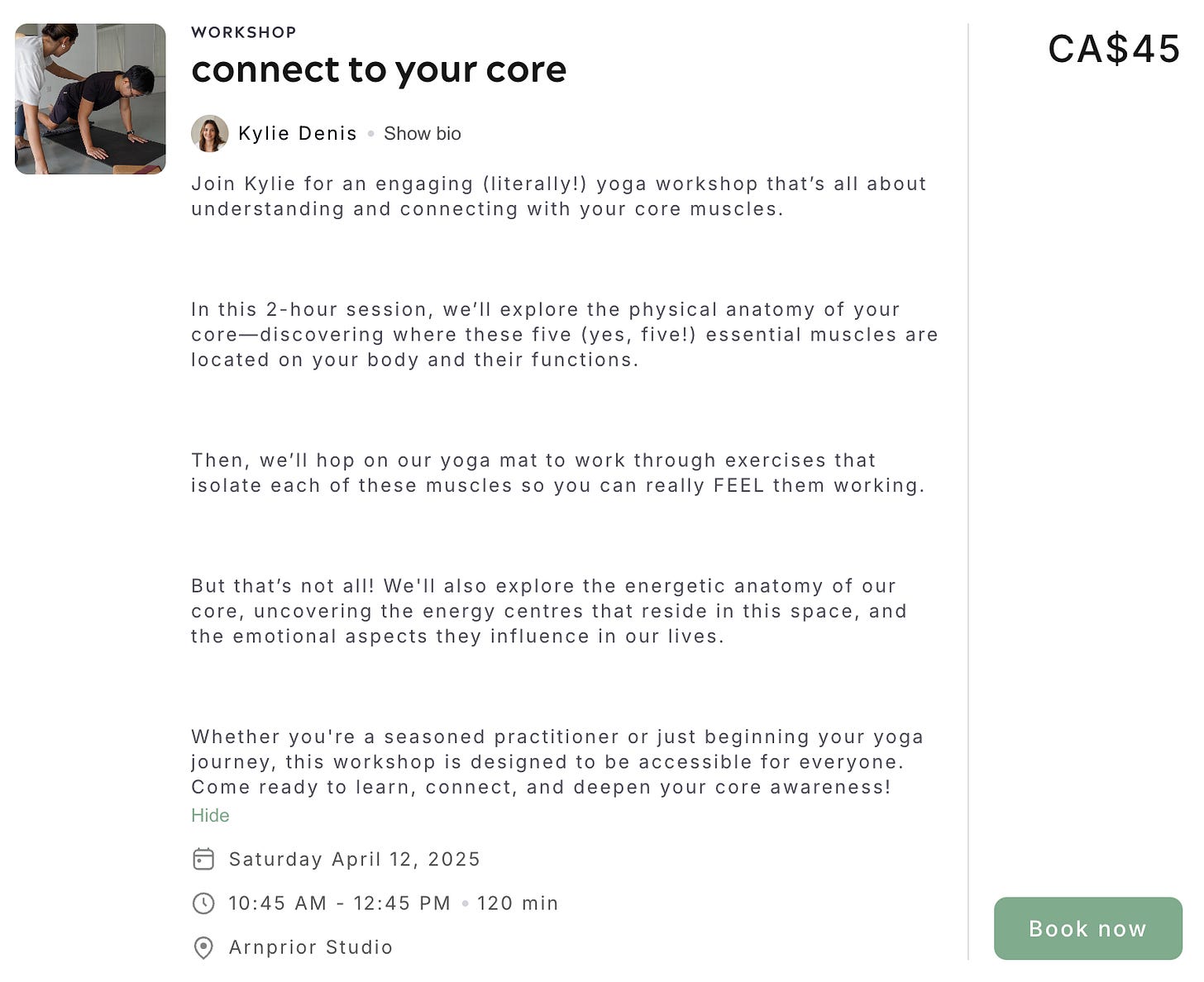
APRIL 12th 10:45am—I’m teaching a 2-hour workshop in-person (!!!!) at Union 108 in Arnprior. If there are any Canadian/Ottawa friends interested—come join!!
MAY—I’m releasing an on-demand version of the above workshop on OMOLOGY ONLINE. It consists of 6x pre-recorded classes:

5x core classes each of which will explore/exercise one specific muscle of the core so you get to really feel and understand what types of movements engage this area of your core.
1x accessible anatomy lesson. Don’t worry—if you (like me) failed biology in school, I promise that this part is actually a lot simpler than it sounds. We talk about all of the muscles (and where they are in our body) in accessible language; no fancy industry-lingo here.
All of our members will receive FREE access to this series when it launches (as always). If you’re not already a member you can become one by signing up for either the monthly or annual membership.

Teachers!
The above workshops can be for you too!!
One of my favourite ways to learn and pick up new teaching techniques is by observing other teachers at work.
Core engagement can be tricky to articulate especially in group fitness classes where time is (usually) of the essence and groups can be really mixed-level. If this is something that you find challenging (or if you’ve been relying on the “engage your core” cue lol) these workshops will not only give you a clear example of how to describe these concepts to multilevel groups (including beginners), they’ll also provide you with several effective core exercises that you can integrate into your own yoga classes.
Can’t wait to meet you on the mat!
xx
love it! thanks for sharing!!